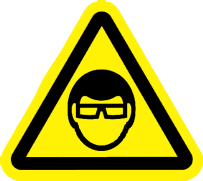
<Wear appropriate personal protective equipment (PPE), such as laser safety goggles and a respirator, during laser processing.>
Laser operation may generate hazardous fumes, fine particles, or optical radiation that can cause eye injury or respiratory issues.

Safety tests were carried out to test the safety and reliability of the machine. The tests have shown that the machine is safe to use when used properly. However, the operator must be aware of and familiar with the safety precautions, guidelines, and warnings regarding the handling of the machine to avoid serious physical harm or machine damage caused by mishandling.
Read and follow the safety precautions carefully. Improper handling of the machine and/or failure to follow the proper handling procedures during machine operation can cause machine damage and injury or harm to the operator. REDT Inc. declines all liabilities and damages caused by mishandling of the machine and/or failure to follow safety protocols.
 |
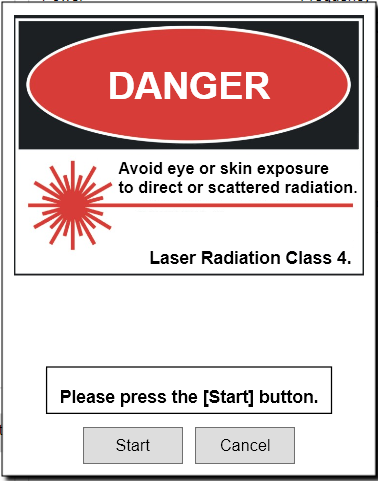
The machine uses a Class IV laser. Any adjustments made on the control and/or operation of the laser (apart from its intended purpose) may result in laser accidents or exposure to hazardous radiation. Direct exposure to laser radiation may cause serious eye injuries and skin burns. Class IV lasers pose the highest risk of injury not only from direct or reflected exposure but also from scattered radiation. These lasers can cause severe damage to the eyes and skin and can ignite flammable materials. Operators must: Contain all radiation and ensure it is eliminated after operation Be informed of laser exposure risks Wear certified PPE including laser-protective goggles Never directly expose yourself to laser radiation. Do not stare at reflected beams without certified PPE. This can result in blindness. |
 |
Never directly expose yourself to laser radiation. Do not stare at the reflected beams without wearing any PPEs or safety goggles. Failure to do so can result in blindness. Class IV laser is considered powerful as it has highly collimated, monochromatic light sources. In other words, Class IV laser beam has a very bright “point source” with a power density that is dangerously high for the retina. On the other hand, the laser beam’s power density becomes less dangerous if it diffuses and scatters onto a non-reflective screen. Therefore, different types of radiation viewing conditions can be distinguished depending on the approach to the radiation itself and the different degrees of risk accompanied by it. ● Direct viewing of the laser beam Direct viewing of the laser beam after removing the lenses is highly dangerous. This type of viewing is considered the most dangerous and must be avoided in every way! No protective goggles can provide immediate protection if the beam is viewed directly. ● Direct viewing of the beam after mirror reflection Direct viewing of the beam after mirror reflection is as dangerous as direct viewing of the laser beam after removing the lenses. Do not directly view the beam reflected from a mirror as the beam strikes on a reflective surface. ● Direct viewing of the beam at the output of an Optical fiber Beam connected from resonator to Optical fiber. Viewing the beam up to a significant distance is dangerous. Filters and goggles cannot guarantee safety. ● Viewing the beam directly after focusing This occurs if the laser beam is not extinguished on a suitable absorber at the end of its useful path. Viewing the beam is dangerous up to a significant distance. Filters and protective goggles can guarantee safety for brief exposure, as long as they are the right size and certified. ● Scattered viewing of the Laser beam after focusing This is the most common viewing condition for equipment in an operative setting. Viewing the beam is not dangerous if not at a short distance, but adequate filters and Goggles can guarantee safety, even for long exposure. |
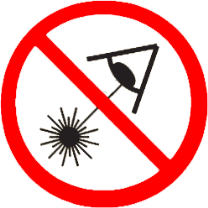 |
Do not look at specular or diffuse reflections – they can still cause blindness. Radiation in the far-infrared range may be invisible yet highly damaging. Radiation is invisible however; being close to the visibility threshold causes the eye to receive it almost entirely with no pupillary reflex. If we add that it is generally very intense, it can be extremely harmful or lethal for the vision. Certain precautions must be followed so as to avoid permanent personal injury. All people who may be exposed to harmful laser radiation levels must know when the laser is active, and if so, they must wear protective eyewear. Due to the high power, the laser integrated in the machine causes laser light to be reflected by flat surfaces. Reflected light is potentially dangerous to the eyes and skin. The electromagnetic emission with micrometric wavelength is located in the far infrared and is therefore invisible, so it is not clear where the reflected beams are directed. ● CAUTION: Direct viewing of a laser beam can cause irreversible damage to the eye. ● CAUTION: It is essential to protect yourself from the beams of reflected light because they can be sufficiently intense to cause permanent damage to the eyes or skin. ● CAUTION: The laser in question falls under class IV. Class IV lasers generate risks not only by direct or reflected radiation but also by diffused radiation. These laser sources can pose a significant hazard for the skin and the risk of fire of inflammable materials. |
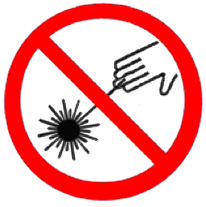 |
Keep all parts of your body away from the machine's working area If subjected to intense laser radiation, even for a brief duration, or to less intense but long-lasting radiation, both the cornea and the retina can burn and be irreparably damaged. This consequence is quite realistic in the case of direct viewing a class IV Laser beam. If subjected to direct focalized radiation, even the skin can burn. Furthermore, it must be considered that collateral radiation can coexist with the main radiation in the ultraviolet: long exposure can cause skin carcinoma. |
 |
Do not use the machine for purposes other than those intended. Otherwise, you could be damaged by laser radiation. |
 |
Appoint a laser safety manager and have him keep monitoring a laser risk and fully understand safety measures. According to each country’s laws, the safety measures for the class-4 laser system are mandatory. (During machine maintenance and control, make sure that the laser radiation is stopped, and safety goggles are put on. The eye/skin exposure to laser radiation can result in serious damage.) In order not to reduce the safety level of the equipment, the User must adopt conforming behavior and in the best possible safe conditions. Therefore, the need arises to develop a Standard Operating Procedure (SOP) in relation to the maneuvers to be carried out for commissioning and decommissioning the equipment. This procedure, which is illustrated near the installation, must be used as a reference for the Operator and will be written in their own language. Personnel training will be essential, which must be aimed at: ● Familiarizing with the operating procedures of the system. ● Knowledge of the biological effects of radiation on Eyes and Skin ● Understanding the need for Personal Protective Equipment (PPE) |
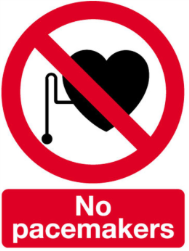 |
If you wear a pacemaker, do not come near the machine or work area. It generates electromagnetic waves and can cause malfunction to the heart rhythm device. |
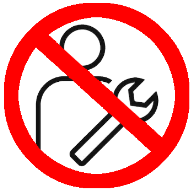 |
NEVER dismantle or modify the machine without authorization Otherwise, you could be exposed to laser radiation and suffer eye/skin damage. In addition, exposure to a high-voltage part can result in an electric shock. An additional risk may be posed by a fire outbreak from processing materials other than those for which the equipment is intended. ● CAUTION: If the intended use of the source is changed, for example for material process applications, collateral risks may arise due to fumes and vapors being generated which may be irritating or toxic if not removed and filtered properly before releasing them back into the environment. ● CAUTION: Since there is a risk of fire when processing flammable materials, it is essential to follow the instructions provided by the manufacturer when commissioning the machine. ● CAUTION: Do not subject material to the laser radiation other than what the equipment was built for. Electricity is certainly the most serious collateral risk associated with a laser device, which may also be fatal. This can arise when the warnings and procedures imposed by the equipment manufacturer are not observed. Unauthorized and inexperienced personnel must never carry out any type of intervention on the electrical part. The safety devices must never be removed and their efficiency must be checked regularly. ● CAUTION: Do not modify the electrical part unless you are an expert. Do not remove the protective devices. ● CAUTION: When processing flammable materials, it is essential to follow the instructions provided by the manufacturer when commissioning the machine. |
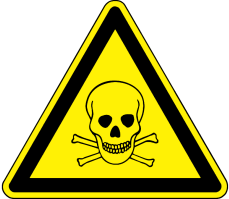 |
Make sure that you have a system which emits the dust and haze which are generated during operation. The warranty does not cover the system damage or failure resulting from corrosive haze. If, for example, during the processing in the intended use of the Laser source, the material is subjected to alterations and produces irritating and/or toxic fumes or vapors, these must be removed and filtered before releasing them back into the environment. An additional risk may be posed by a fire outbreak from processing materials other than those for which the equipment is intended. ● CAUTION: Do not subject material to the laser radiation other than what the equipment was built for. ● CAUTION: Since there is a risk of fire when processing flammable materials, such as plastics, it is essential to follow the instructions provided by the manufacturer when commissioning the machine. |
| If any defect is found, do not use the machine and contact the Authorized technical support(+82-70-7011-0905) or seller. |
¶ Safety Labels
The laser system has seals in some points. For no reason whatsoever must the seals be broken or removed.
The sealed parts, in fact, can only and exclusively be opened by the manufacturer.
Labels and plates must not be removed or damaged. For any replacements, contact the seller or the manufacturer.
Breaking or removing seals affixed to the laser system by the manufacturer immediately renders the warranty on the entire laser system null and void.
¶ Warning Labels
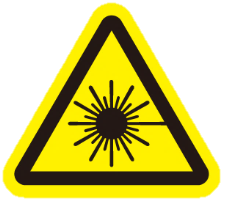
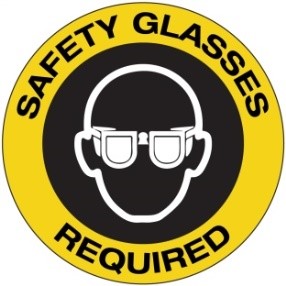
This label indicates that the operator must be informed of the risks from exposure to laser radiation and must be equipped with the appropriate PPE (personal protective equipment), which consists of certified protective goggles against laser radiation.
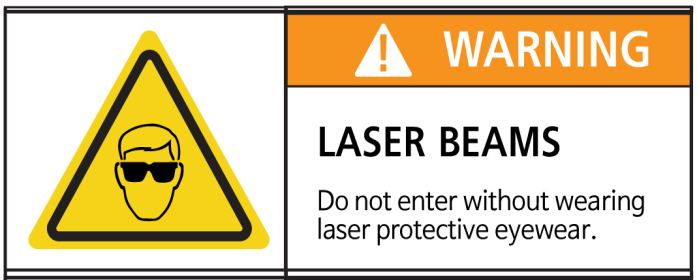
This label indicates the presence of the laser without specifying the class it belongs to.
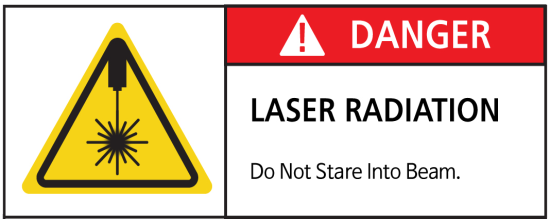
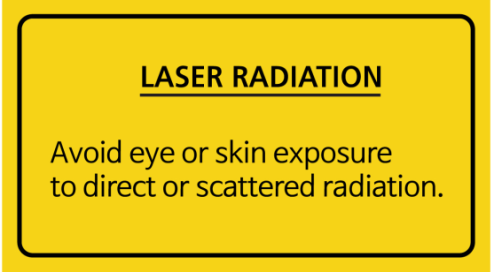
This label indicates the presence of the laser, specifying the class it belongs to.
[프로그램에 표시]
¶ For your safety
Carefully read the warnings in this section before using the laser machine. Make sure that all warnings and instructions displayed on the machine are observed. The following warnings are indicated to ensure our machines are used safely and to prevent damage or injury to operators or other persons. Make sure that you have taken all the precautions indicated in the manual; all precautions are important for personal and work safety.
THE LASER MACHINE CAN BE DANGEROUS
Protect yourself and others from potential serious injury or death. Always wear protective eyewear. Keep children away from the machine. Persons with pacemakers must stay away from the machine, unless they have specific medical permission. Operators may be exposed to certain risks when using lasers. Laser machine is safe if the necessary precautions are adopted. Risks related to marking are limited to handling manufactured machines. The laser process is safe when used as intended. In any case, it is important to delegate machine use only to authorized personnel. The installation, maintenance and repairs of the machine must be delegated to manufacture personnel or to its authorized engineers.
ELECTRICAL DISCHARGES CAN BE FATAL
Contact with live electrical parts can have fatal consequences or cause severe burns. Incorrect installation or grounding the machine can be dangerous.
- Do not touch live parts. Remove the power cable from the power socket before installing or performing maintenance on the machine.
- Install and ground the machine properly, in accordance with the user manual and in full compliance with local regulations and standards.
- Turn the machine off after use.
- Do not use cables that are weak or damaged, with an insufficient section or poorly connected.
- Make sure the cables are positioned away from sources of heat.
- Use the device only if it is in perfect condition. Make sure that the damaged parts are immediately repaired or replaced.
- Make sure that all the cover panels remain fixed and in place.
SWITCH THE MACHINE OFF IMMEDIATELY IN CASE OF MALFUNCTIONING
If smoke or unusual odors are emitted from the equipment, immediately unplug the power cable, while taking care to prevent burns or damage. Continuous use of the laser machine in such conditions can cause serious injury and/or damage. The device must only be examined by manufacture technical personnel or by their authorized engineers.
DO NOT ATTEMPT TO DISMANTLE THE EQUIPMENT
The internal components of the device can cause injury. If the machine malfunctions, it must only be repaired by skilled manufacture personnel.
DO NOT USE IN THE PRESENCE OF FLAMMABLE GAS
Prevent the risk of explosion or fire by not using the equipment in environments saturated with flammable gas with minimal ventilation. Always keep a fire extinguisher nearby.
FUMES AND GAS CAN BE HAZARDOUS TO HEALTH
The laser processes produce fumes and gas. Inhaling these can be dangerous to human health.
- Keep your head away from the fumes. Do not inhale the fumes.
- Do not cover any part of the machine.
- Carefully read the instructions for the various types of materials that can be laser welded.
- It is preferable to use a large room specifically designed for the equipment to be used. If the room is small, make sure it is well ventilated.
- Do not weld near degreasing, cleaning or steaming areas. The heat can react with the vapors, thereby producing very toxic and irritating gas.
- Make sure the materials used do not contain impurities that could produce fumes or gas during laser marking.
LASER CAN GENERATE A FIRE OR EXPLOSION
Sparks and overheating can be generated during the processing of the marking materials and cause a fire and/or burns. Accidental contact of the overheated parts with the gas cylinder could cause an explosion.
- Do not laser weld where the sparks could come into contact with flammable material.
- Remove all flammable objects found near the laser machine. If this is not possible, cover them correctly with flame retardant material.
- It is important to be aware of the risks of fire: always keep a fire extinguisher nearby.
- Actively supervise the machine during operation.
LASER RADIATION CAN CAUSE INJURIES TO THE RETINA AND BURNS TO THE SKIN
Uncontrolled reflections of the LASER beam can cause burns or, in the worst case, irreversible damage to the retina.
Never weld on reflective objects.
Reproduction, transmission, transcription, insertion into a data recovery system, translation into any language, in any form and by any means, is strictly prohibited without prior authorization. REDT Inc.reserves the right to modify the hardware and software information in this manual at any time without notice. REDT Inc.declines all liability for any kind of damage caused by using this machine. Despite our attempt to make sure this documentation is as complete and accurate as possible, we kindly ask you to immediately inform REDT Inc.of any errors or omissions.
¶ Laser Generator Specifications
The machine utilizes a laser generator and a CLASS 4 laser source in accordance with IEC60825-1, JIS C6802 and FDA(CDRH) Part 1040.10.
- CLASS 4: Class 4 laser is a powerful laser that is considered dangerous and poses great risk of injury if exposed from direct or reflected laser radiation. This type of laser can cause serious harm to the eyes and skin, and can cause flammable materials to catch fire.
| Type | Ytterbium Doped Fiber Laser | |
| Model | JANUS-30W | JANUS-60W |
| Power | 30W | 60W |
| M² | <1.4 | <1.8 |
| Maximum Pulse Energy | 0.8mJ | 1.5mJ |
| Pulse Repetition Rate Range | 1~4,000 KHz | |
| Pulse Width | 2~350ns | 2~500ns |
| Speed Range | 4,000mm/s | |
| Wavelength | 1,064nm | |
| Output Beam Diameter | 7.0±0.5mm | |
| Cooling Method | Air-cooled | |
| Polarization | Randomd | |
| Anti-Reflection Protection | Yes | |
| Built-in Guide Laser | Yes | |
| Class (Main Source) | Class 4 | |
¶ Laser Specifications
The machine utilizes red laser ‘CLASS 2’ as a guide laser.
- CLASS 2: Class 2 laser is a relatively weak laser that is considered safe for normal operation. Its visible beam does not cause any harm or damage on a person’s eye unless deliberately stared into it. It is not a skin or materials burn hazard as well.
| Class | Class 2 |
| Power | <1mW |
| Wavelength | 650nm |
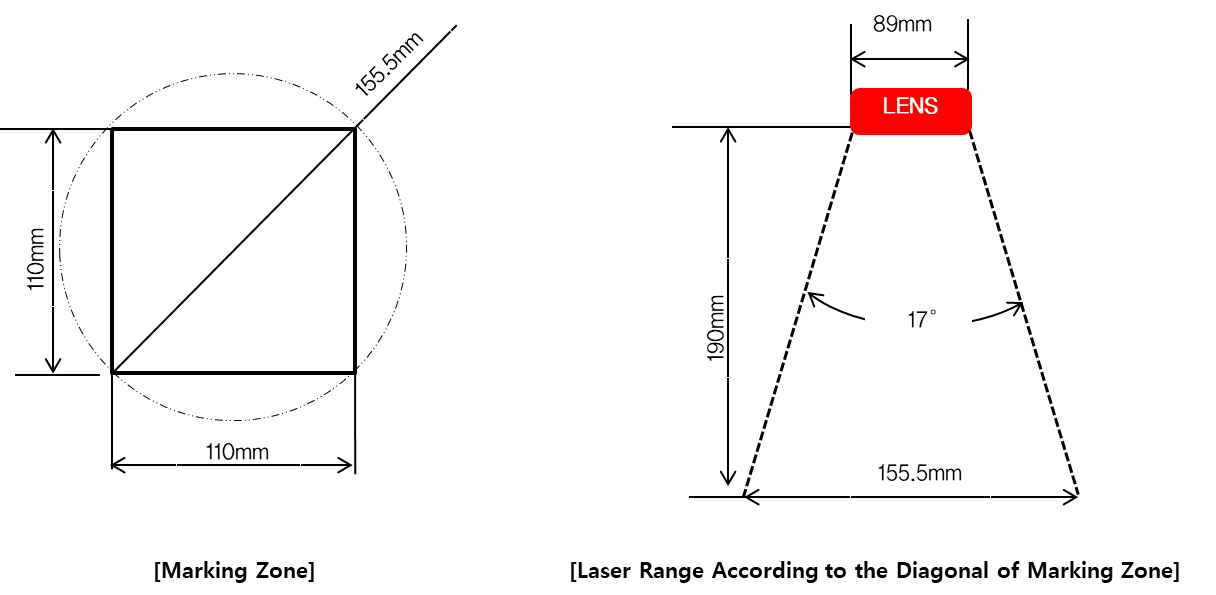
¶ Laser Range
If a body part or a flammable material is placed within the range of laser radiation, this will result in injury or fire. Considering the risk of this range, cover the laser with a protective film with appropriate reflectivity and thermal properties for safety.
(The marked distance represents the maximum width. It may differ from actual values.)